The Coming Transformation
Prediction: By 2040, 50-60% of jobs automated Reality check: AGI doesn’t eliminate humans—it concentrates human value
The question isn’t whether you’ll have a job in 2028. It’s whether your job will be one that AGI amplifies or replaces.
Part 1: The AGI-Powered Company Structure
Before vs. After
| Aspect | Traditional Company (2025) | AGI-Powered Company (2028+) |
|---|---|---|
| Size | 100-10,000 employees | 10-100 humans + 100s of AI agents |
| Layers | 5-10 management levels | 2-3 levels |
| Decision speed | Weeks-months | Real-time |
| Cost structure | Human-labor heavy | Compute-heavy |
| Competitive advantage | Scale, capital | Speed, adaptation |
The One-Person Organization
What becomes possible:
1 CEO + 10 AI Agents + Cloud Infrastructure = $10M Revenue Company
Not hypothetical:
- Solo founders already building $1M+ revenue businesses with AI
- By 2028, the ceiling rises to $10M+
- By 2030, $100M+ solo companies become possible
But: This doesn’t mean companies get smaller. It means they get more ambitious.
Part 2: The Humans Who Still Matter
Category 1: Strategic Leadership (Amplified, Not Replaced)
CEO/Founders:
| Task | Who Does It | Why |
|---|---|---|
| Vision & values | Human | AGI can’t define purpose |
| Strategic direction | Human + AGI | Human sets goals, AGI optimizes |
| Stakeholder relationships | Human | Trust is human-to-human |
| Crisis decisions | Human | Accountability requires humans |
The CEO-AGI partnership:
CEO: "What are our options for entering market X?"
AGI: "Here are 47 scenarios with probability distributions..."
CEO: "What about the risk to our culture?"
AGI: "That's not in my training data. That's your call."
Why CEOs survive:
- Accountability can’t be delegated to AI
- Stakeholders (investors, customers, employees) want human commitment
- “The buck stops here” requires a human
C-Suite Evolution:
| Role | 2025 | 2028+ |
|---|---|---|
| CFO | Financial modeling, reporting | Strategy + AGI oversight |
| CTO | Technical roadmap | AI integration + risk management |
| CMO | Campaign management | Brand vision + AI coordination |
| CHRO | Hiring, policy | Culture + human development |
The shift: From doing tasks to directing AI agents that do tasks.
Category 2: Creative & Strategic Roles (AGI-Augmented)
AI Strategists / Prompt Engineers:
What they do:
- Translate business goals into AGI instructions
- Optimize AGI outputs for specific contexts
- Design human-AGI workflows
- Maintain AGI alignment with company values
Why they matter:
- AGI is powerful but not self-directing
- The gap between mediocre and excellent AI use is human judgment
- Competitive advantage comes from better AI utilization
Content Creators & Designers:
The evolution:
Before (2025): Creator writes drafts, edits, publishes
After (2028): Creator directs AGI, curates, adds human perspective
What remains human:
- Taste and judgment
- Brand voice
- Emotional resonance
- Cultural context
R&D Researchers & Innovators:
The AGI advantage:
- AGI processes literature in hours (humans: months)
- AGI runs thousands of experiments in parallel
- AGI identifies patterns humans miss
The human role:
- Frame the right questions
- Judge which findings matter
- Navigate ethical implications
- Build on intuition that AGI can’t replicate
Category 3: Ethics, Oversight & Human-Centered Roles (New Demand)
AI Ethics Specialists / Auditors:
Why this role emerges:
- AGI systems can produce harmful outputs
- Regulatory requirements for AI oversight
- Public trust depends on demonstrated responsibility
- AGI alignment is an ongoing process, not a one-time fix
What they do:
- Audit AGI decisions for bias
- Ensure compliance with regulations
- Review AGI behavior in edge cases
- Translate ethical principles into AGI constraints
Data & Cybersecurity Specialists:
The new reality:
- AGI systems are high-value targets
- AGI can be weaponized by adversaries
- Securing AGI infrastructure is critical
- Managing AI supply chains
Human Relationship Managers:
What AGI can’t do:
- Build genuine trust
- Navigate complex emotions
- Handle high-stakes negotiations
- Provide human connection
Where humans remain essential:
- Key account relationships
- Complex sales
- Team building and culture
- Crisis management
Category 4: Roles That Disappear or Shrink
Basic Developers / Programmers:
The prediction: AGI writes 95% of code by 2028
What remains:
- Architecture decisions
- Code review and approval
- Novel algorithm design
- Security-critical systems
Administrative & Clerical Roles:
What gets automated:
- Scheduling
- Data entry
- Document processing
- Basic correspondence
What remains:
- Complex coordination
- High-stakes communication
- Discretion and judgment
Junior Analysts:
The AGI advantage:
- Faster data processing
- More comprehensive analysis
- No fatigue or errors in routine tasks
What happens:
- Junior roles shrink dramatically
- Entry-level becomes mid-level
- On-the-job learning becomes harder
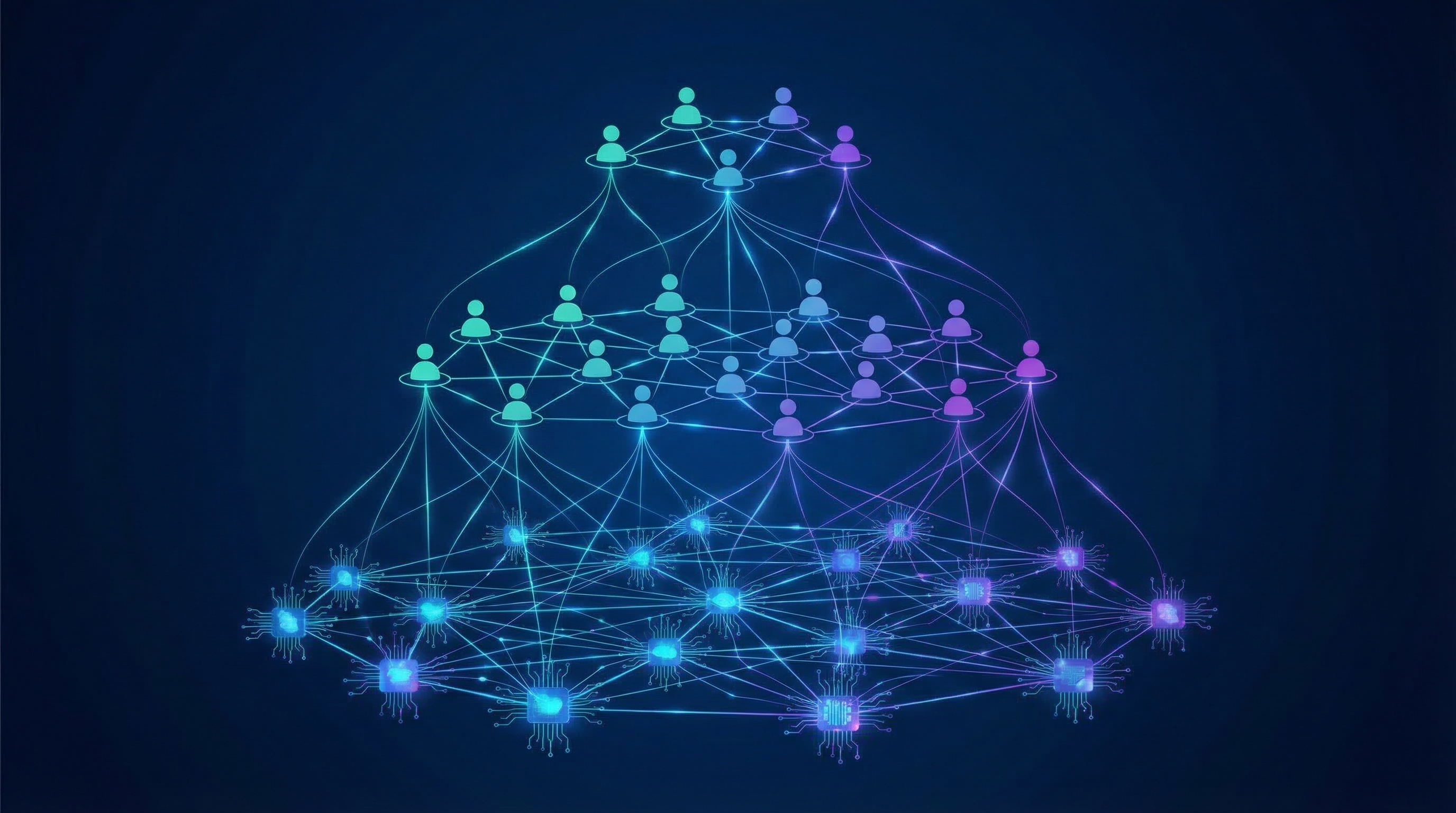
Part 3: The New Company Structure
Layer 1: Strategic Humans (5-10% of workforce)
Roles:
- CEO/Founder
- C-Suite
- Senior strategists
- Key relationship holders
Responsibility:
- Set direction
- Make high-stakes decisions
- Maintain accountability
- Define values and culture
Layer 2: Tactical Humans (15-20% of workforce)
Roles:
- AI strategists
- Domain experts
- Creative directors
- Ethics specialists
Responsibility:
- Direct AGI agents
- Ensure quality and alignment
- Bridge human and AI systems
- Maintain competitive advantage
Layer 3: AGI Agents (75-80% of “workers”)
Types:
- Research agents
- Analysis agents
- Creative agents
- Operational agents
- Communication agents
The critical insight: AGI agents don’t replace Layer 1 and 2 humans—they amplify them.
Part 4: The Adaptation Framework
For Individuals
Skills that gain value:
| Category | Examples |
|---|---|
| Strategic | Vision, prioritization, judgment |
| Creative | Original thinking, taste, curation |
| Interpersonal | Trust-building, negotiation, empathy |
| Ethical | Values, principles, responsibility |
| Technical (new) | AI direction, prompt engineering, oversight |
Skills that lose value:
| Category | Examples |
|---|---|
| Routine | Data processing, templated work |
| Information | Retrieval, summarization |
| Analysis (basic) | Standard patterns, routine insights |
| Technical (old) | Manual coding, system administration |
For Companies
Immediate actions (2026):
- Map which roles AGI can amplify
- Identify strategic human roles
- Begin AI integration experiments
- Develop human-AI workflows
Medium-term actions (2027-2028):
- Restructure for human-AGI hybrid
- Invest in AI direction skills
- Build ethics and oversight capabilities
- Create new roles for AGI coordination
Long-term actions (2028+):
- Scale with AGI, not humans
- Maintain human accountability
- Focus on judgment and relationships
- Stay adaptable to AGI evolution
For Society
The challenge:
- Fewer workers needed for same output
- Wealth concentration risk
- Transition pain for displaced workers
- Purpose crisis for those without roles
The opportunity:
- Productivity explosion
- New types of value creation
- More meaningful work (less drudgery)
- Faster problem-solving
The Takeaway
AGI doesn’t eliminate human value—it concentrates it.
The humans who thrive after 2028 will be those who:
- Direct AGI rather than compete with it
- Provide judgment that AGI can’t replicate
- Build relationships that require human trust
- Take responsibility that can’t be delegated
- Create meaning in an AGI-powered world
The company of 2028: Smaller, faster, more ambitious—and still fundamentally human at its core.
Sources
Related Posts
- The Next 3 Years: AI Agents Take Over — Part 1
- When AI Joins Democracy — Part 2
- AI Agent Registration — Part 3
This is Part 4 of the AI Future Series. The series explores the next 3 years of AI development and its impact on society, governance, and work.