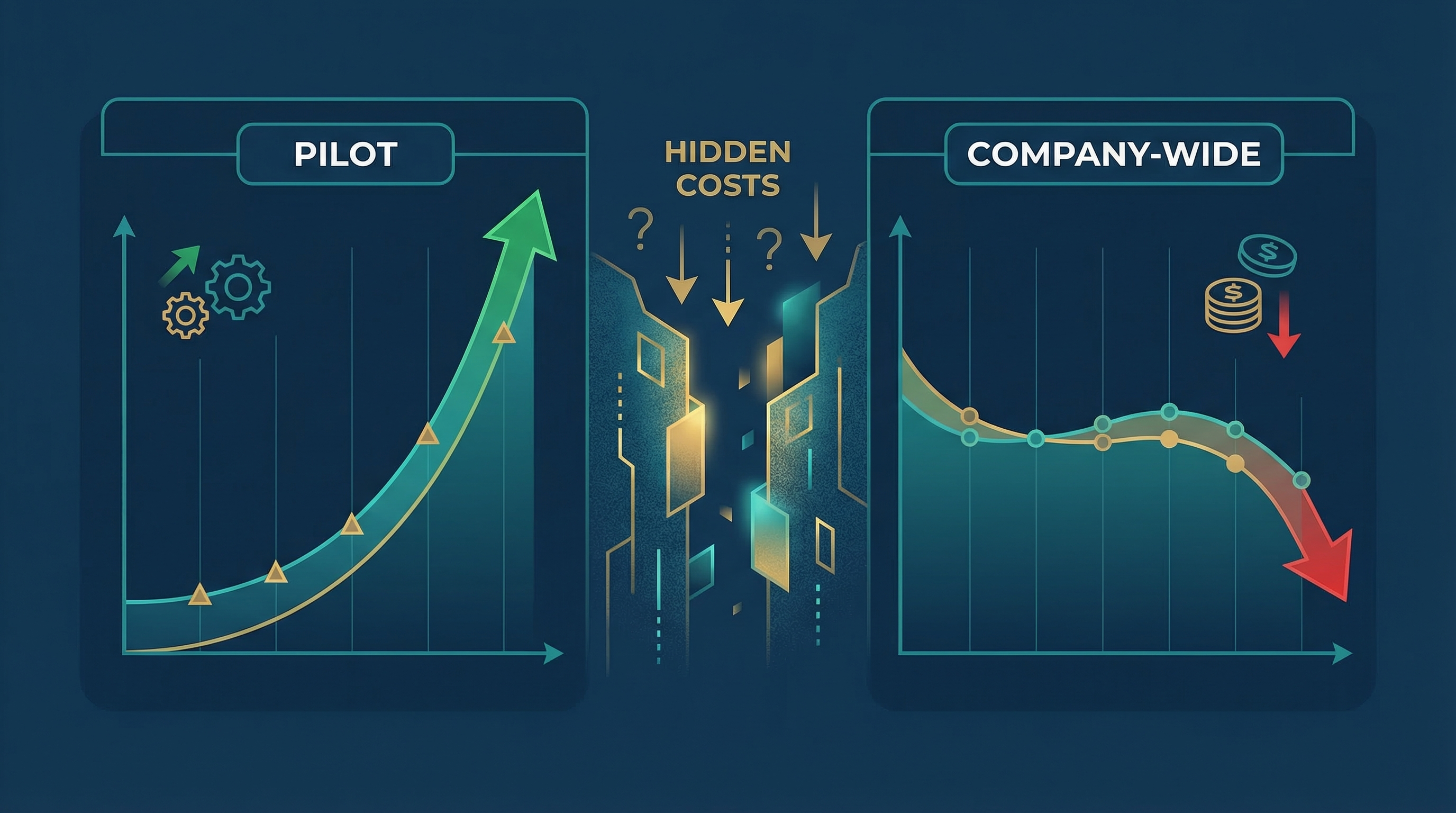
The 42% Problem
S&P Global (2025): 42% of AI initiatives were scrapped entirely.
That’s up from 17% the year before.
What’s killing these projects? The data is clear:
| Abandonment Reason | Percentage |
|---|---|
| Data quality issues | 38% |
| Business case no longer viable | 29% |
| Loss of executive sponsorship | 21% |
| Technical approach infeasible | 12% |
The Hidden Variable: Executive Sponsorship
What the Numbers Say
Digital Applied (2026): Executive alignment reduces AI project failure by 67%.
Fierce Healthcare: Senior leaders (CTOs, chief data officers, chief AI officers) who champion AI projects secure budget and organizational support needed to move from pilot to production.
The pattern:
No executive sponsor → Pilot succeeds → Stuck in limbo → Gets scrapped
Executive sponsor → Pilot succeeds → Gets budget → Scales to production
Why This Happens
| Without Champion | With Champion |
|---|---|
| Budget gets questioned | Budget protected |
| Competing priorities win | AI stays priority |
| Promising pilots stall | Pilots move to production |
| Teams lose momentum | Teams get support |
The 67% Effect
Digital Applied’s finding: Executive alignment reduces failure by 67%.
What this means practically:
Baseline failure rate: ~80% (without alignment)
With executive alignment: ~26% (67% reduction)

That's the difference between:
- 8 out of 10 projects failing
- 2-3 out of 10 projects failing
Why Technology Isn’t the Problem
The Tech vs. Org Gap
Most organizations focus on:
| Tech Questions | Org Questions (Neglected) |
|---|---|
| Which LLM to use? | Who owns this initiative? |
| How to integrate? | What’s the success metric? |
| What’s the cost? | Who defends the budget? |
| Security? Compliance? | Who removes obstacles? |
The uncomfortable truth:
AI tools are commoditizing. The technology gap is closing.
The organizational gap is widening.
The Champion Problem: A Real Example
Scenario A: No Champion
Month 1: Team gets excited about AI
Month 2: Pilot launches successfully
Month 3: Budget questions emerge
Month 4: Competing priorities take resources
Month 6: Pilot stalls, team moves on
Month 9: Project quietly scrapped
Scenario B: With Champion
Month 1: CTO champions AI initiative
Month 2: Pilot launches, champion tracks progress
Month 3: Budget questions → Champion defends
Month 4: Obstacles emerge → Champion removes them
Month 6: Pilot proves value, champion scales budget
Month 9: Production deployment
What Makes a Good Champion
The Three Essentials
| Characteristic | Why It Matters |
|---|---|
| Budget authority | Can protect and expand funding |
| Cross-functional influence | Can remove organizational barriers |
| Patience for ROI | Understands 3-12 month realization timeline |
Who Should It Be
| Role | Best When |
|---|---|
| CTO / CIO | AI is technical infrastructure |
| Chief Data Officer | AI is data strategy |
| Chief AI Officer | AI is core business strategy |
| CEO / COO | AI is company-wide transformation |
The Framework: Getting (and Keeping) a Champion
Step 1: Identify the Right Champion
Ask: Who loses if this project fails?
Who gains if it succeeds?
Who can write the check?
Step 2: Build the Business Case
Don’t lead with AI excitement.
Lead with:
| Business Problem | AI Solution | Success Metric |
|---|---|---|
| Meeting documentation takes 5 hrs/week | AI meeting notes | 3 hrs/week saved |
| Sales deal velocity too slow | AI-powered CRM insights | 15% faster deals |
| New hire ramp-up takes 6 months | AI training documentation | 40% faster onboarding |
Step 3: Define Success Metrics Upfront
Bad: “We’ll use AI to improve productivity”
Good: “We’ll reduce meeting documentation time by 50% within 90 days”
Step 4: Report Progress Regularly
Monthly:
- Wins: What’s working
- Learnings: What’s not
- Needs: What champion should unblock
Step 5: Celebrate Wins Publicly
Give champions credit for success. They’ll fight harder for the next project.
The ROI Reality
Timeline Expectations
| Phase | Duration |
|---|---|
| Evaluation | 2-4 weeks |
| Security Review | 2-6 weeks |
| Pilot | 4-8 weeks |
| Full Rollout | 8-16 weeks |
| ROI Realization | 3-12 months |
Champions need patience.
Most failures happen in months 3-6—exactly when champions get distracted.
The Takeaway
95% of AI pilots fail.
42% get scrapped entirely.
67% of failures could be prevented with executive alignment.
The math is clear:
AI technology is not the bottleneck.

Organizational support is.
If you’re starting an AI initiative:
- Find a champion BEFORE you start
- Define business metrics, not AI metrics
- Report progress monthly
- Give champions credit for wins
If you’re a leader:
- You don’t need to understand the technology
- You DO need to protect the budget and remove obstacles
- Your involvement determines whether pilots become production
Sources
- Pertama Partners: AI Project Failure Statistics 2026
- Arcast Group: The ROI of AI
- Fierce Healthcare: Why 95% of AI Projects Fail
- Complex Discovery: MIT’s 2025 Study
Related Posts
- The AI Productivity Paradox — Why 95% fail and what works
- AI Future: Next 3 Years — What happens when AI agents arrive
The question isn’t whether your AI pilot will work technically. It’s whether you have someone with budget authority who will defend it when competing priorities emerge.