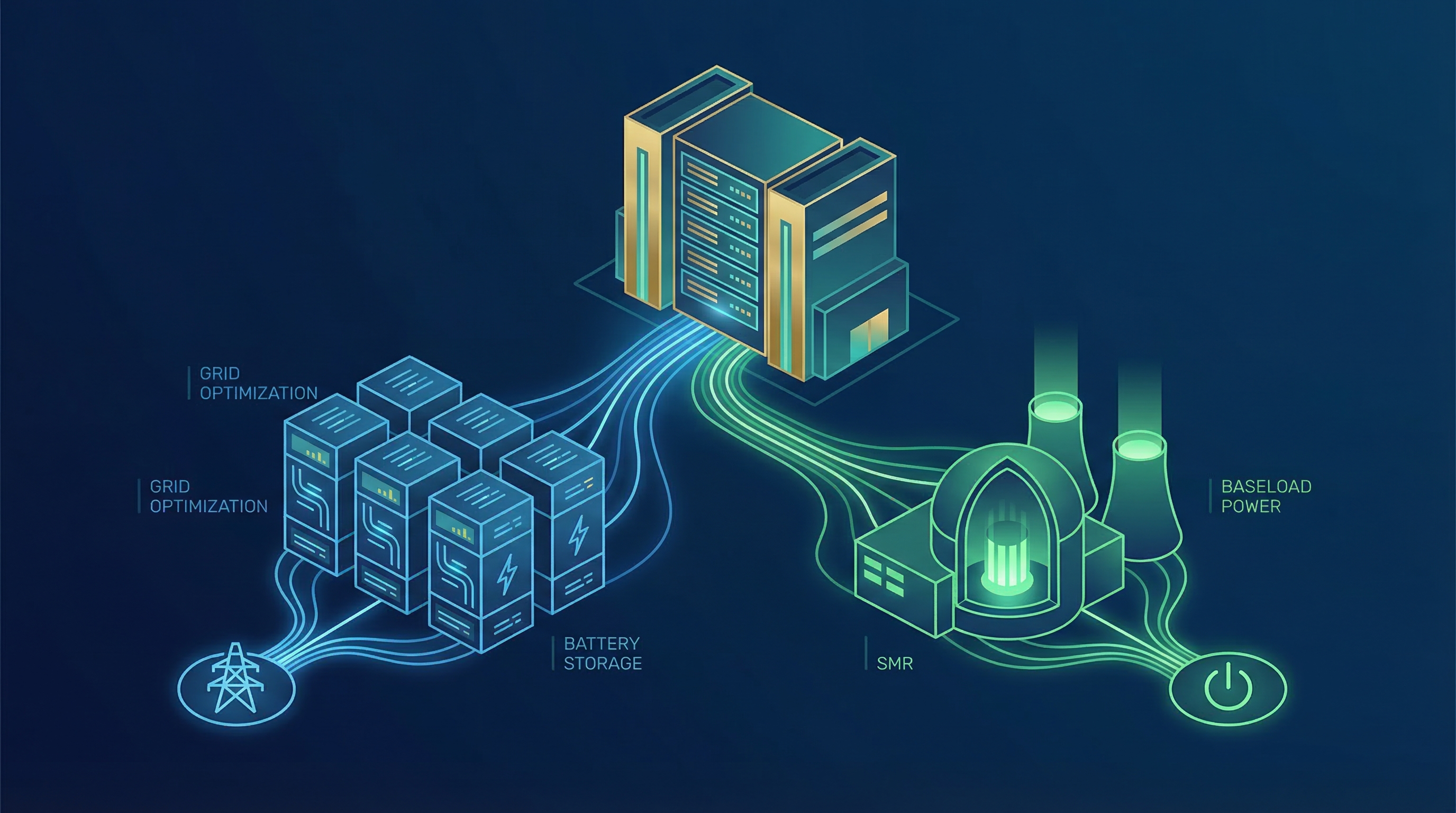
The Problem: 100GW, But No Grid#
The Numbers#
| Metric | Value |
|---|
| Data center power demand by 2030 | 100 GW |
| Average grid connection delay | 3-5 years |
| New transmission line timeline | 7-10 years |
| Data center growth rate | 25% annually |
The gap:
Data centers are being built faster than the grid can connect them.
Data center construction: 18-24 months
Grid connection: 3-5 years (if lucky)
New transmission: 7-10 years
Solution A: Batteries as Grid Buffers#
Why Batteries Work#
The core insight:
Building new power plants → 5-10 years
Building new transmission → 7-10 years
Installing batteries → 12-18 months
Batteries don’t generate power. They optimize what already exists.
How It Works#
| Function | Mechanism | Benefit |
|---|
| Peak Shaving | Discharge during peak hours | Reduces grid load |
| Grid Buffer | Stand between grid and data center | Smooths demand spikes |
| Time Shifting | Charge at night (cheap), discharge during day (expensive) | Cost savings |
| Backup Power | Instant failover during outages | Reliability |
The Architecture#
Traditional:
Grid → Transmission → Data Center
       (bottleneck here)

Battery-enabled:
Grid → Transmission → [Battery Buffer] → Data Center
                          ↑
                    Absorbs peaks, provides backup
Real Example: Tesla Megapack#
Night (2 AM):
- Electricity price: $20/MWh
- Grid charges battery

Day (2 PM):
- Electricity price: $150/MWh
- Battery discharges to data center
- Grid load reduced

Result:
- Data center gets power
- Grid doesn't need upgrade
- Operating costs lower
Cost Parity Achieved#
| Metric | 2020 | 2026 |
|---|
| Battery pack cost | $140/kWh | $80/kWh |
| vs. Gas peaker | More expensive | Cost competitive |
| LCOE (storage) | $150/MWh | $90/MWh |
Key stat: Battery storage now competes with gas peaker plants on cost.
Investment Plays: Battery Storage#
| Company | Ticker | Focus | Notes |
|---|
| Tesla | TSLA | Megapack | Leading utility-scale storage |
| Fluence | FLNC | Storage software/systems | Pure-play storage |
| Stem | STEM | AI-powered storage | Storage optimization |
| NextEra Energy | NEE | Utility + storage | Integrated player |
| Enphase Energy | ENPH | Distributed storage | Residential/commercial |
Solution B: SMRs for Baseload Power#
The Long Game#
| Metric | Batteries | SMRs |
|---|
| Timeline | Deploy now | 2030+ commercialization |
| Function | Grid optimization | Power generation |
| Capacity | Hours of storage | 24/7 baseload |
| Carbon | Depends on grid mix | Zero-carbon |
Why SMRs matter:
Batteries = optimize existing power
SMRs = add new carbon-free baseload
EU SMR Strategy (2026)#
| Target | Value |
|---|
| First SMRs online | Early 2030s |
| Projected capacity by 2050 | 17-53 GW |
| EU investment announced | €200 million |
Data Center Connection#
| Development | Significance |
|---|
| NuScale-Framatome partnership | Accelerating fuel supply chain |
| Tech company interest | Google, Microsoft exploring SMR PPAs |
| Grid connection delays | SMRs can bypass transmission constraints |
Investment Plays: SMRs & Nuclear#
| Company | Ticker | Focus | Notes |
|---|
| NuScale | SMR | SMR developer | First US-design certification |
| Cameco | CCJ | Uranium fuel | Fuel supplier |
| Uranium Energy | UEC | Uranium mining | Growth play |
| BWX Technologies | BWXT | Nuclear components | SMR parts |
Comparison: Batteries vs. SMRs#
| Factor | Batteries | SMRs |
|---|
| Deploy timeline | Now | 2030+ |
| Revenue visibility | Immediate | Long-term optionality |
| Capital intensity | Lower | Higher |
| Regulatory risk | Lower | Higher |
| Scalability | High | Limited initially |
| Market maturity | Established | Early stage |
Investment Framework#
Near-Term (2025-2028): Battery Storage#
Thesis: Grid congestion + cost parity = structural demand

Play: Storage developers, utilities adding storage, battery suppliers

Risk: Tariffs on Chinese batteries, technology obsolescence
Long-Term (2030+): SMRs & Nuclear#
Thesis: Data center baseload demand + zero-carbon mandates = SMR opportunity

Play: SMR developers, uranium suppliers, nuclear components

Risk: Regulatory delays, cost overruns, competition from other baseload
Portfolio Approach#
| Allocation | Asset Class | Timeline |
|---|
| 60% | Battery/storage stocks | Near-term revenue |
| 25% | Utilities with storage | Regulated returns |
| 15% | SMR/nuclear optionality | Long-term upside |
Key Risks#
| Risk | Impact | Mitigation |
|---|
| Tariffs on batteries | Cost increases | Geographic diversification |
| Technology shifts | Obsolescence | Focus on software/systems players |
| Regulatory delays (SMR) | Timeline push | Stick to near-term battery plays |
| Ratepayer backlash | Policy reversal | Focus on data center PPAs |
The Takeaway#
Two timelines, two solutions:
| Timeline | Solution | Investment Focus |
|---|
| 2025-2028 | Batteries solve grid congestion | Storage developers, utilities |
| 2030+ | SMRs provide baseload power | SMR developers, uranium |
The insight:
Batteries don't replace power plants.
They make existing infrastructure work better.

SMRs don't optimize the grid.
They add new carbon-free capacity.

Both are needed.
Sources#
Related Posts#
Data centers need power. The grid can’t deliver fast enough. Batteries bridge the gap today. SMRs build the future tomorrow. Both are investable—but on different timelines.