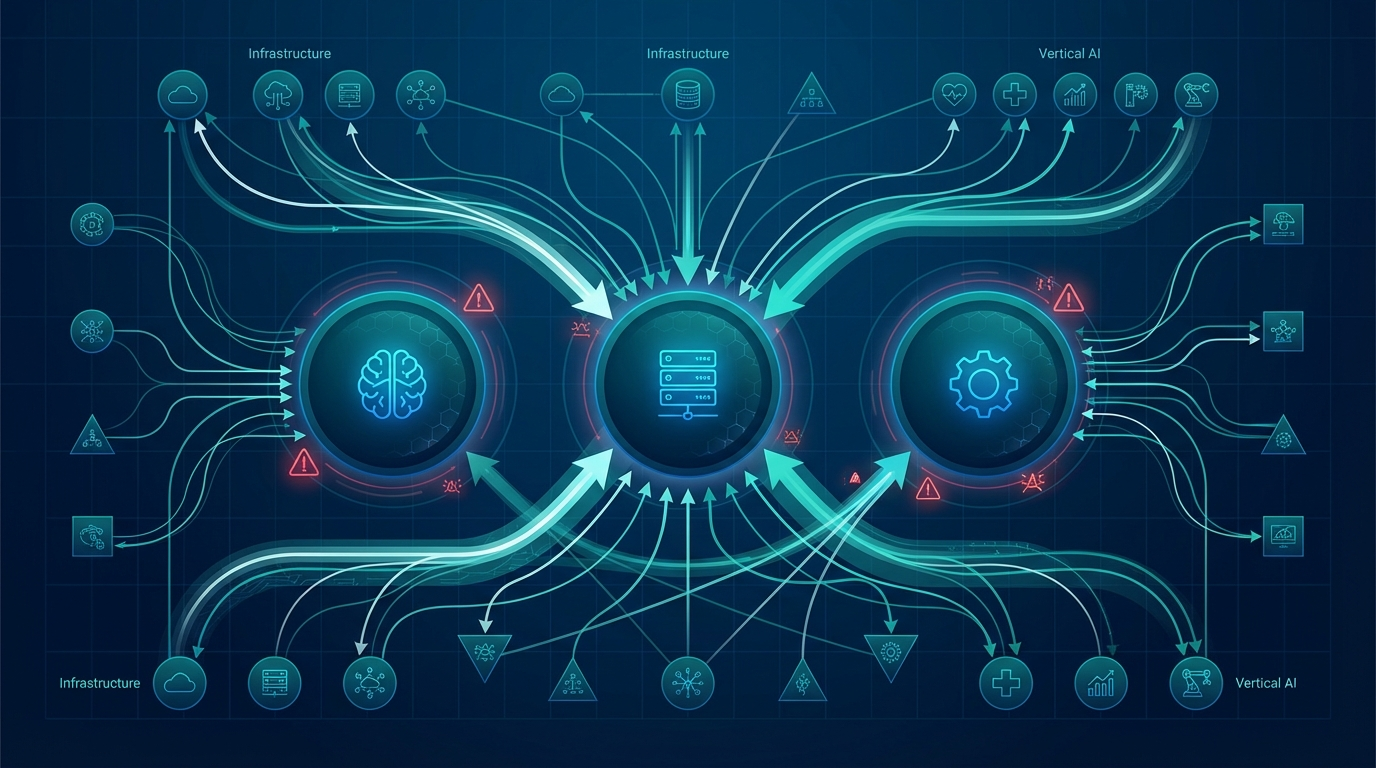
AI funding concentration visualization

AI Funding Q1 2026: $200B Flood Meets Concentration Crisis

The Paradox $200 billion flooded into AI in Q1 2026 — more than all of 2023. But here’s the uncomfortable truth: Portfolio diversification just died. The top 3 AI companies (OpenAI, Anthropic, xAI) raised $160B+ combined. That’s 80% of all AI funding going to 3 players. The Numbers Mega-Rounds Dominate Company Round Valuation Key Signal OpenAI $40B $300B Largest private round ever Anthropic $35B $60B Enterprise AI premium xAI $20B+ $120B+ Musk’s GPU empire Databricks $10B $62B Data infrastructure moat Scale AI $10B+ $50B+ Data labeling bottleneck Total Q1 AI funding: $200B+ Top 5 companies’ share: ~85% ...


March 24, 2026 Â· 3 min Â· 632 words Â· Den Kim

Why PropTech Outpaces Legacy Industries: The AI Synergy That's Creating a Perfect Storm

The Numbers Don’t Lie PropTech CAGR (2024-2034): 16% Compare that to: Traditional real estate: 3-5% Construction: 4-6% Financial services: 5-7% Retail: 4-6% Manufacturing: 3-4% PropTech is growing 3-4x faster than average legacy industries. But growth rate alone doesn’t tell the full story. The real question is: Why now? And more importantly: Why is AI synergy so uniquely powerful in real estate? Part 1: Why PropTech Is Accelerating Now 1. The Last Frontier Effect Real estate was the last major industry to digitize: ...

March 9, 2026 Â· 7 min Â· 1329 words Â· Den Kim

February 2026: The $189B Venture Month That Changed Everything

The Month That Broke All Records February 2026 will be remembered as the month venture capital went supernova. $189 billion invested in startups worldwide—a 780% surge from the previous year. To put this in perspective, this single month matched the entire Q4 2023 global VC activity. But the real story isn’t the headline number. It’s what this unprecedented capital concentration reveals about the future of tech investing. The Numbers That Matter The Triple Threat Dominance 83% of all funding went to just 3 companies: ...

March 7, 2026 Â· 5 min Â· 1060 words Â· Den Kim

AI Coding Tools for Non-Developers: Which One Should You Actually Use?

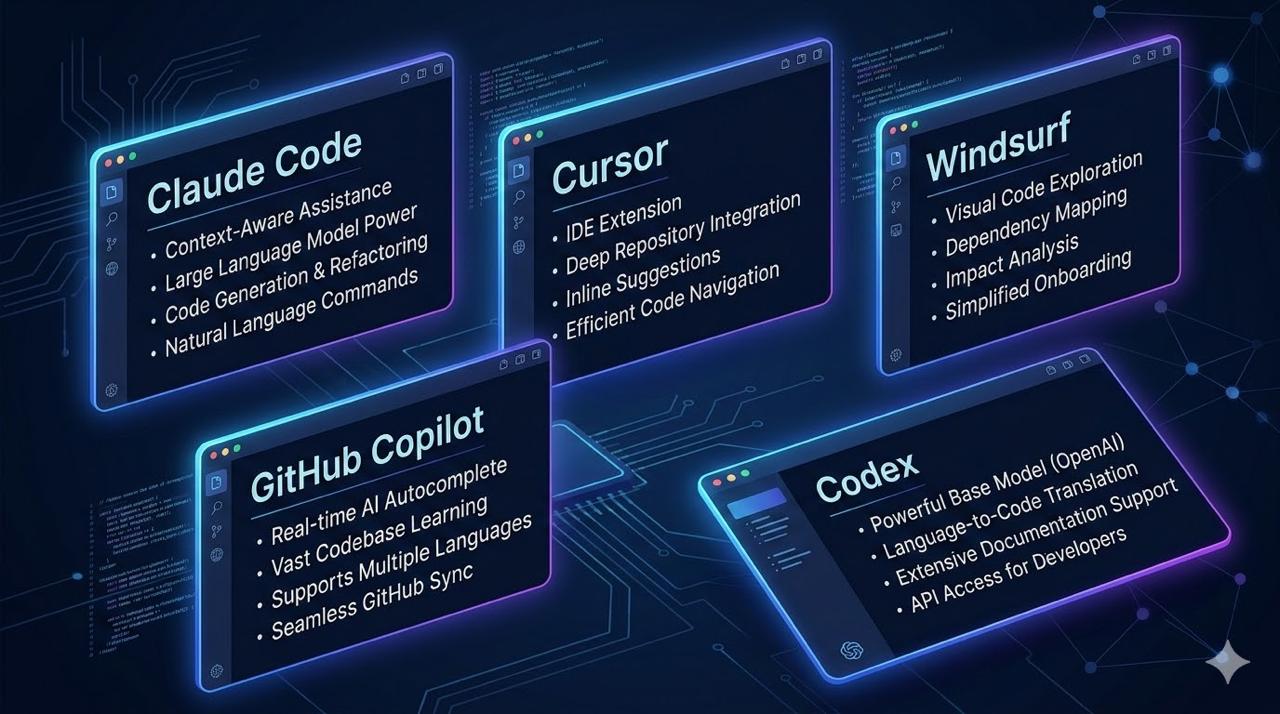
Why Non-Developers Care About “Coding” Tools Here’s the uncomfortable truth: the best AI tools for non-developers are often labeled “coding tools.” Why? Because they’re built to: Read and understand your files Execute multi-step tasks autonomously Connect to your existing tools (Slack, Google Drive, Notion) Sound familiar? That’s exactly what you need — regardless of whether you write code. Let’s compare the six most powerful options from a non-developer perspective. The Six Contenders Tool What It Is Primary User Claude Code Terminal-based AI agent Power users, complex tasks Claude Cowork Desktop AI agent (no terminal) Knowledge workers, non-developers Cursor VS Code fork with AI embedded Content creators, markdown users Windsurf VS Code-based IDE with Cascade AI Budget-conscious teams GitHub Copilot AI plugin for existing IDEs Microsoft ecosystem users OpenAI Codex Cloud-based coding agent ChatGPT Pro/Enterprise users At a Glance: Non-Developer Comparison Factor Claude Code Claude Cowork Cursor Windsurf Copilot Codex Learning Curve Moderate Low Low Low Very Low Low Requires Coding? No No No No No No Terminal Required Yes No No No No No Desktop App No Yes Yes Yes Plugin ChatGPT Best For Complex tasks Knowledge work Writing Budget Microsoft ChatGPT users Context Window 200K+ 200K+ ~120K ~100K ~32K 192K MCP Support Best Best Good Good Limited Good Monthly Cost $20-100+ $20-100+ $20 $15 $10-39 $20-200 Claude Code vs Claude Cowork: What’s the Difference? Claude Cowork launched in January 2026 as a research preview. It’s essentially Claude Code’s agentic capabilities — without the terminal. ...

March 5, 2026 Â· 7 min Â· 1318 words Â· Den Kim

Claude Code for Non-Developers: Real Workflows That Actually Save Time

The Secret Non-Developers Are Missing Everyone talks about Claude Code as a “coding assistant.” But here’s what they don’t tell you: You don’t need to code to use it. In the past month, I’ve watched product managers, content strategists, and financial analysts get 5-10 hours of their week back—without writing a single line of Python. Here’s how they’re doing it. What Claude Code Actually Does (Non-Technical Version) Think of Claude Code as a research assistant who: ...

March 5, 2026 Â· 5 min Â· 982 words Â· Den Kim

Why Iran's IRGC Structure Could Defeat AI Warfare: The Decentralization Advantage

The Overlooked Counter-Move When analysts discuss AI in warfare, they focus on speed: faster decisions, faster targeting, faster execution. The assumption is that whoever has better AI wins. But there’s a blind spot: adversaries adapt structurally, not just technologically. Iran’s Islamic Revolutionary Guard Corps (IRGC) has spent two decades building a command structure specifically designed to survive exactly the kind of AI-enabled warfare that Pentagon planners envision. The Centralization Trap Why AI Favors Hierarchies AI excels at: ...

March 4, 2026 Â· 4 min Â· 793 words Â· Den Kim

AI and the Speed of War: Geopolitical Risk in the Algorithm Age

The Question No One’s Asking The Middle East is boiling. Iran-Israel tensions have reached a boiling point. The US is deploying carrier groups. But amidst the headlines, a deeper structural question emerges: Will AI make wars faster—or not? The answer has profound implications for defense, energy, and technology investments. Hypothesis 1: AI Accelerates Warfare The OODA Loop Compression Colonel John Boyd’s OODA loop (Observe-Orient-Decide-Act) has governed aerial combat since the 1950s. AI compresses this cycle from minutes to milliseconds. ...

March 4, 2026 Â· 5 min Â· 961 words Â· Den Kim

7 Notion AI Agent Use Cases That Actually Save Time (Real Examples)

The Problem with AI Chatbots Most AI tools wait for you to ask. You type a prompt, get an answer, and move on. But the real work—the repetitive tasks that eat your day—doesn’t happen in single prompts. It happens in multi-step workflows: Reading meeting notes across 5 teams Triaging 50 IT tickets per week Compiling weekly status reports for leadership Notion Custom Agents (launched Feb 2026) solve this differently: give them a job, set a trigger, and they work 24/7. ...

March 1, 2026 Â· 5 min Â· 980 words Â· Den Kim

AI Washing and the White-Collar Transformation: What History Teaches Us

The AI Panic Narrative In February 2026, Block (formerly Square) announced large-scale layoffs, explicitly citing AI as the reason. The headlines wrote themselves: “AI is taking white-collar jobs.” Citron Research amplified the fear: white-collar unemployment could hit 10% by 2028, triggering a global financial crisis. The narrative is seductive. It’s also incomplete. What’s Really Happening: AI as Corporate Cover The “AI Washing” Phenomenon When Block announced AI-driven layoffs, critics noted an inconvenient truth: Block had overhired dramatically during the pandemic. This wasn’t AI replacing humans—it was executives using AI as plausible deniability for restructuring. ...

February 28, 2026 Â· 5 min Â· 1027 words Â· Den Kim

From 51 Days to 5: How Tavant's Agentic AI Transformed Legacy Mortgage Operations

The Problem: Mortgage’s $10,000 Paper Problem The mortgage industry has a dirty secret. Despite decades of digitization efforts, the average loan still takes 51 days to close and costs over $10,000 to originate. Why? Because the middle and back office remain stuck in paper-based, human-dependent workflows: Loan officers manually enter data from physical documents Processors chase missing information across multiple systems Underwriters review hundreds of pages per loan Compliance teams audit paper trails This isn’t inefficiency—it’s structural. The mortgage process was designed for a world where humans were the only processors, paper was the only medium, and 45-60 day cycles were acceptable. ...

February 28, 2026 Â· 6 min Â· 1127 words Â· Den Kim